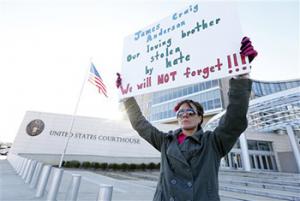
Ten white Mississippi Teens, now young men and women, have been found guilty of random hate crimes against blacks, which included the murder of an unsuspecting victim, James Craig Anderson.
A group of young white men and women who killed Anderson, a black man in Jackson, Mississippi, in 2011 had periodically roamed the city that spring, attacking African Americans at random, and police never heard about it.
Their last attack, before dawn on June 26, 2011, killed 47-year-old auto plant worker James Craig Anderson and sparked a multiyear federal investigation that ended Wednesday after a ninth...
Written by: The Associated Press
What value did a bidder find in the Ku Klux Klan robe that was purchased at an auction? Curiosity? History? Tucked between children's Victorian-era button-down shoes and a World War I collar bag, one item stood out on an auctioneer's website touting an end-of-the-year sale: a Ku Klux Klan robe dating to the 1920s.
The white robe, discovered in an attic by a New Hampshire woman in her 80s, bore the KKK's distinctive round, scarlet patch with a white cross. For years, it sat in a bag, assumed by family members to be an innocuous garment and not a feared symbol of the white supremacist group....
The Ku Klux Klan cannot continue leafleting streets according to a U.S. Circuit Court of Appeals. However, the American Civil Liberties Union is appealing the ruling that prohibits the Ku Klux Klan from leafleting in the streets of a small southeast Missouri town.
In a 2-1 ruling last week, a panel of the 8th U.S. Circuit Court of Appeals sided with the city of Desloge, whose leaders argued the ordinance is meant to protect public safety by keeping people out of the street, not suppress free speech.
ACLU attorney Anthony Rothert said Wednesday that the case will be appealed to the full 8th...
Are there elements of white supremacy, in principal or practice, embedded in the Republican Party? The question is being asked as Republican lawmakers closed ranks Sunday behind the No. 3 House Republican leader as the party aimed to move past the controversy over his speech 12 years ago to a white supremacist group.
House Majority Whip Steve Scalise of Louisiana has said the speech was a mistake he now regrets, and party leaders, including House Speaker John Boehner, have backed him.
Several incoming rank-and-file lawmakers added their support Sunday, including Utah's Mia Love, the first...
Written by: Nedra Pickler - Associated Press
Racism and the Republican Party, is there fire where there is smoke? The White House on Monday waded into a controversy over revelations that the House's No. 3 Republican spoke to a white supremacist group 12 years ago, saying who the Republicans have in leadership "says a lot about who they are."
White House Press Secretary Josh Earnest repeatedly said Steve Scalise once described himself as "David Duke without the baggage." A reporter for the New Orleans Advocate newspaper said Scalise made the remark to her as he was starting out in the Louisiana Legislature nearly 20 years ago. Scalise's...
Written by: Cain Burdeau - Associated Press
Blacks win a settlement for a housing discrimination case where they were restricted from renting in new areas that had been rebuilt following Hurricane Katrina. A settlement has been reached in a long legal fight over St. Bernard Parish housing policies that allegedly restricted black people from renting in the parish as it rebuilt after catastrophic damaged caused by flooding from Hurricane Katrina.
An advocacy group that investigates complaints of discrimination, the Greater New Orleans Fair Housing Action Center, said Friday that St. Bernard has agreed to settle the case for $1.8 million...
Written by: Jeffrey Collins
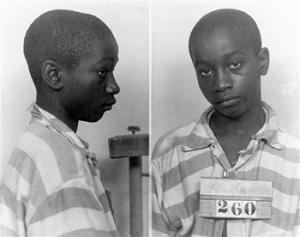
The youngest black boy to be executed has been deemed as a great miscarriage of justice. More than 70 years after South Carolina sent a 14-year-old black boy to the electric chair in the killings of two white girls in a segregated mill town, a judge threw out the conviction, saying the state committed a great injustice.
George Stinney was arrested, convicted of murder in a one-day trial and executed in 1944 - all in the span of about three months and without an appeal. The speed in which the state meted out justice against the youngest person executed in the United States in the 20th century...
Written by: Jacques Billeaud - Associated
Arizona sheriff Joe Arpaio will end his popular and notorious business raids as pressure continues to mount on his office’s arrest tactics and practices. The Arizona sheriff known for crackdowns on people living in the country illegally is giving up his last major foothold in immigration enforcement efforts that won him popularity among voters but gradually were reined in by Washington and the courts.
Maricopa County Sheriff Joe Arpaio's office revealed late Wednesday that it was agreeing to disband a controversial squad that has raided businesses to arrest more than 700 immigrants who were...